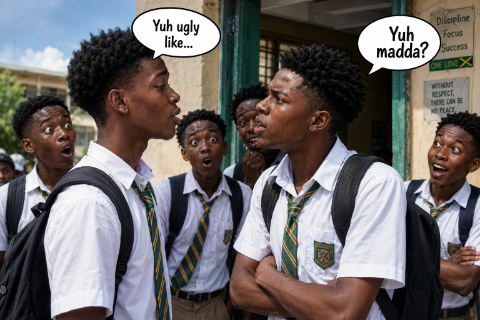
I would love for someone to explain to me why Jamaicans so frequently “double-up” their words. Has anyone at the University taken the time to study this curious phenomenon? Its obvious that some examples of this occurrence are just English words that we’ve gotten into the habit of saying twice, perhaps for the sake of emphasis. (Perhaps its easier to simply double-up a word than to find additional words to help emphasize a point?) Or perhaps it’s a part of a Jamaican penchant for deliberate over-exaggeration in our descriptions of even mundane things? Other words appear not to be English at all and perhaps may have been passed down to us by our African ancestors? Consider the following examples:
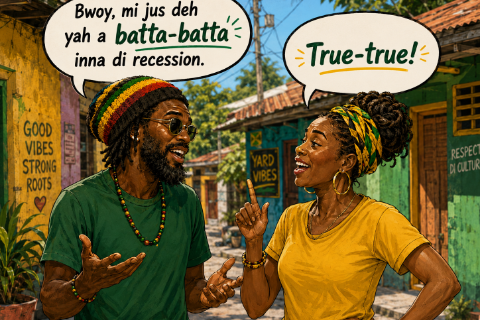
Batta batta: To survive or merely get by. E.g. “How yuh stay Ralston?”
“Bwoy Lenny, mi jus deh yah a batta batta inna di recession”
Bumpy-bumpy: Very bumpy. Covered in bumps. e.g. “Gweh! Yuh face bumpy-bumpy like jackfruit!”
Cabba-cabba: Uncivilised people. “Is when Parliament get so full of cabba-cabba?”
Chacka-chacka: Untidy. Disorganised.
Cyass-cyass: A noisy quarrell or controversy. (See Ray-ray) Studies have shown that the persons most likely to be involved in cyass-cyass are fool-fool, cabba-cabba people who enjoy the mix-up and ray-ray.
Deady-deady: Unexciting. Boring. Convetional Jamaican wisdom is that deady-deady relationships often lead to infidelity. e.g. “Leroy, mi tyad ah the deady-deady lovin. If yuh nuh careful yuh ah go find Joe Grind inna yuh life!”
Degeh-degeh: Singly. By itself.
Dibby-dibby: Not worthy of respect. A dibby-dibby girl is best avoided. A dibby-dibby, licky-licky girl should be shunned like the plague.
Dooguh-dooguh: Sexual intercourse. What’s popularly known today as “daggering”. (Popularly known in places where it hasn’t been completely banned by the Broadcasting Commission, that is.)